Winner Profile: How Maha Jouini is bringing Arab, Muslim and African women's voices into global AI governance
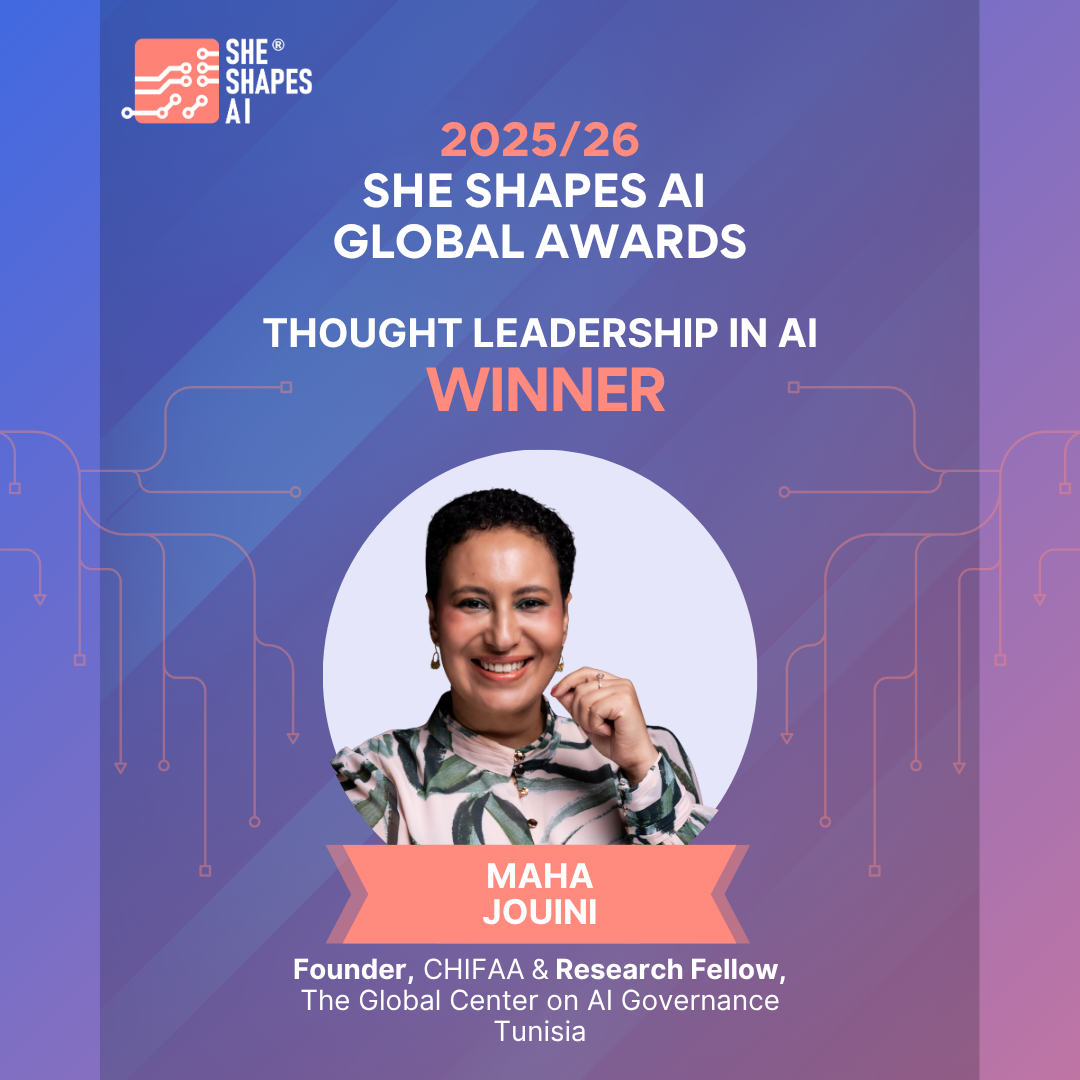
Maha Jouini is an AI ethics and policy advocate working to embed Arab, Muslim and African women's narratives into global AI governance. Based in South Africa, she works at the Global Center on AI Governance and leads the Women in Focus Initiative, which has spotlighted over 40 women in AI from North Africa and francophone Africa. She won the She Shapes AI Global Award for Thought Leadership in AI at the 2025/26 She Shapes AI Conference and Global Awards Ceremony, held on 16 April 2026 at the London School of Economics.
Maha's work is grounded in a conviction that the absence of certain voices from AI policy is not an oversight. It is a design failure with consequences for the billions of people those systems will affect. Through multilingual writing, public speaking, radio and community engagement, she makes AI governance accessible to communities historically excluded from it, bringing the concepts into local languages and cultural contexts where people can encounter them through identity and lived experience rather than technical abstraction.
She is a UNESCO MENA Top 20 AI Changemaker and a Women in AI Ethics honouree. She is also a breast cancer survivor, a fact she does not separate from her professional work. Her own experience as what she calls outlier data, a patient whose cultural realities and bodily autonomy were not reflected in the systems meant to support her, gave her advocacy its sharpest edge. She founded Chifaa, meaning healing in Arabic, an AI companion designed for women with breast and cervical cancer in North Africa, built on multilingual and multi-dialectal Arabic and shaped around the cultural specificities of the region.
On what it means to bring lived experience into technical policy spaces, and why the future of AI cannot be left only to technologists, Maha speaks with characteristic precision and warmth.
Lived experience is not separate from expertise. It is part of it.
When Maha reflects on what being recognised as a She Shapes AI Global Award winner means to her, the answer moves quickly beyond the personal.
"Being recognised as a She Shapes AI Global Award winner represents more than personal recognition for me. It is a recognition of the importance of bringing human dignity, cultural diversity and lived experience into conversations about artificial intelligence. As a North African woman working at the intersection of AI governance, health, ethics and social impact, this recognition reminds me that voices from the Global South belong in shaping the future of technology."
She received the award while navigating cancer treatment. That context, she says, gave the recognition even greater meaning. "It reminded me that vulnerability and leadership can coexist, and that lived experience is not separate from expertise. It is part of it."
The problem AI is reproducing, and the communities it is forgetting
At the core of Maha's work is a problem she describes with precision: AI systems are being built without reflecting the realities of communities in Africa and the Arab world, particularly women navigating healthcare, inequality and digital marginalisation. As AI rapidly shapes healthcare, education, governance and everyday life, the cost of that exclusion is not abstract.
"If we fail to build inclusive and human-centred systems today, we risk reproducing global inequality through technology at an even larger scale."
Chifaa, the AI companion she is building for women with breast and cervical cancer in North Africa, was born directly from this gap. Maha describes the moment she was diagnosed with cancer and realised that, as a single woman, she had no legal right to egg freezing in her country. Her identity, under the legal framework she was navigating, was defined entirely through male relation: as someone's sister, daughter or wife. As a single woman, her right to fertility decisions did not exist.
"This reality has to be included in any technological system coming into my region." Chifaa is built to hold exactly this kind of knowledge: multilingual, culturally specific, and designed around the realities that women in the region actually face.
Responsible AI requires everyone in the room
Asked how responsible AI shows up in her work in practice, Maha points first to governance structure, both within her own projects and in the broader ecosystem around her.
"Responsible AI is not a slogan. It is embedded in how systems are designed, governed and experienced by people."
In Chifaa, this means building with doctors, AI practitioners, communication experts and multidisciplinary stakeholders to ensure the technology remains accountable to human realities. MahaBot, her decolonial chatbot hosted on her website, explains AI policy concepts through Arab-Islamic ethical frameworks, making governance accessible to non-technical audiences in familiar cultural language.
But her sharpest frustration is with how AI governance is organised at the national and regional level. She describes attending a workshop on AI in education in Tunisia and being struck by how completely siloed the institutions were: the Ministry of Education working alone, the Ministry of Communications working alone, researchers and engineers working alone. "The ethicists have to sit down with the policymakers, with the engineers, with everyone." Across the African continent, she observes the same fragmentation. Technologists working in one space. Philosophers and legal experts in another. The result is advocacy that cannot speak with a unified voice at the moment it matters most.
"Don't give the future only to technologists. I am a technologist, but I cannot design the future by myself."
Leadership as courage, culture and civilisational dialogue
For Maha, leadership in AI means having the courage to shape technology not only around efficiency and innovation, but around humanity itself.
She draws an unexpected reference point: Steve Jobs, and his public acknowledgement of Arabic calligraphy as an influence on Apple's design philosophy. For Maha, that moment was not a small detail. It was a signal that culture from her region had shaped one of the most influential technology companies in the world, and that the design sensibility of her ancestors had been seen and honoured at the highest level of global innovation.
"I said, if Steve Jobs, who doesn't read Arabic, came up with Apple, then what am I, as an Arab woman, going to do?"
The fact that Jobs also navigated cancer before his death gave Chifaa another layer of personal meaning. She describes naming the project partly as a tribute: a determination to build something that might help other survivors live in a way that the technology of his time could not help him.
The framework she is pushing for, across her writing, her policy advocacy and her AI projects, is what she calls civilisational dialogue: a demand that the era of agentic AI be shaped not only by those who build the machines, but by those who understand what it means to be human across the full breadth of the world's cultures, languages and histories.
What comes next
Maha continues to build across several parallel fronts. Chifaa is in development, with work underway to ensure it is built with and for the women it is designed to serve. MahaBot continues to grow as a public resource. Her policy paper on AI governance in Africa, developed with the Global Center on AI Governance for the Center for Women and Young Girls with Chronic Diseases, is advancing the case for chronic illness perspectives to be embedded in AI ethical frameworks.
Her digital platforms reach over 31,000 followers on Facebook and thousands of monthly readers on her website. Her Ubuntu Radio conversation on reclaiming Africa's digital future reached over 10,000 listeners. Her writing has been published in and highlighted by Stanford, UNESCO networks and international platforms.
The vision driving all of it is an AI future where forgotten narratives are restored, dignity is non-negotiable, and communities co-author the technologies that shape their lives. Maha Jouini is already building it.
Learn more about Maha's work at chifaa.org and follow the Women in Focus Initiative at the Global Center on AI Governance.
The 2026/27 She Shapes AI Global Awards Call for Applications opens on 8 October 2026. If you or someone you know is driving positive impact through AI, sign up to our newsletter to stay informed.
She Shapes AI is the global catalyst for women-led, responsible AI innovation. Founded in 2024 by Dr Julia Stamm FRSA. sheshapes.ai