Winner Profile: How Sorina Uleia is turning satellite data into real ocean cleanups with Recycllux
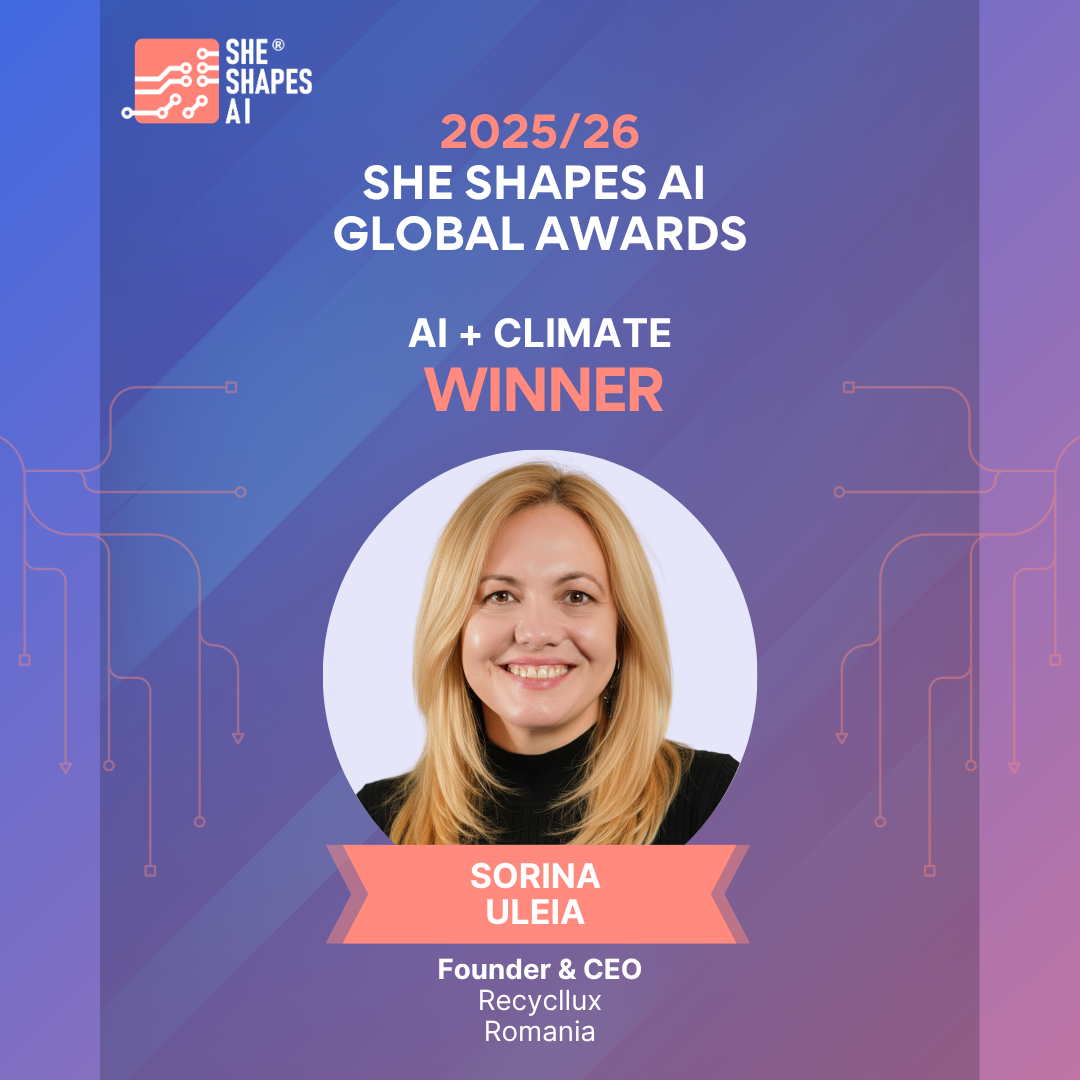
Sorina Uleia is the Founder and CEO of Recycllux, a Romanian deep tech startup using Earth observation, AI, and blockchain to tackle marine plastic pollution. She won the She Shapes AI Global Award in the AI + Climate category at the 2025/26 She Shapes AI Conference and Global Awards Ceremony, held on 16 April 2026 at the London School of Economics.
Recycllux is built on a conviction that runs through every design decision Sorina has made: detection without intervention changes very little. The platform uses proprietary AI algorithms to analyse satellite imagery from Sentinel-1 radar and Sentinel-2 optical data, identifying marine plastic accumulation zones along coastlines. Once hotspots are confirmed through ground-truth validation with coastal NGOs and fishing vessels, local communities are coordinated to carry out cleanups. Every stage of the process, from detection through collection, sorting, and reintegration, is logged on blockchain, generating audit-grade data for corporate ESG reporting and regulatory compliance. Recycllux's community-led model emits 46 times less carbon than traditional ship-based operations.
Sorina spent nearly 20 years in enterprise technology, working in business development roles at IBM, Oracle, and Indra Sistemas. She was co-founder of ChemChain, a blockchain-based chemical traceability company acquired by 3E in 2023. The origin of Recycllux was more personal than professional. She was swimming with her children in the Black Sea when she found herself surrounded by floating plastic. What struck her was not the pollution itself but what it represented: a system designed to produce this outcome, with no one accountable for stopping it. She had the experience and the tools to act. The choice not to felt impossible to explain to her children.
On building AI that creates accountable action rather than impressive dashboards, Sorina speaks with the precision of someone who has thought carefully about every layer of the system she is building.
Validation for a broader idea about who shapes AI
For Sorina, the award carries meaning beyond Recycllux.
"Being recognised validates not only what we are building, but also the idea that AI should create measurable action in the real world. Ocean innovation and deep tech have traditionally had limited female representation. Being recognised is an opportunity to show that women can lead ambitious, highly technical companies tackling global challenges."
She frames the recognition as a signal beyond her own company: evidence for the next generation of AI-for-impact founders that this kind of work, complex, technical, and community-embedded, is being seen and taken seriously.
Responsible AI means closing the gap between visibility and action
Asked how responsible AI shows up in practice at Recycllux, Sorina offers a definition that shapes every layer of how the platform is built.
"Responsible AI means that technology must lead to accountable action. Not just better visibility."
In practice, this means AI outputs at Recycllux are never treated as unquestionable. Satellite detection identifies probable hotspots; ground-truth validation with local NGOs and fishing vessels confirms them before any intervention is coordinated. Transparency is built into the system through blockchain: every cleanup is tracked, creating traceable records of what was collected, where, by whom, and how it was processed. The intent is to prevent environmental claims from becoming marketing narratives without verification.
The model is also designed to create direct economic benefit for the coastal communities doing the work, not just for the companies and authorities commissioning it. "Responsible AI means resisting the temptation to optimise for attention instead of impact. In climate and sustainability, it is easy to create impressive dashboards. What matters is whether the technology actually changes outcomes in the real world."
Choosing the harder layer
The defining decision in building Recycllux was a deliberate choice not to stop at detection.
"Early on, it would have been much easier to stop at detection: beautiful satellite visualisations, dashboards showing where pollution exists. This is often where environmental technology platforms end. We realised that visibility is good, but without intervention, it changes very little."
Building the connection between satellite detection and real-world operational response, coordinating fishing vessels, coastal NGOs, sorting logistics, and material reintegration, is considerably harder than building a visualisation tool. But it is the layer that makes the work meaningful. "Technology alone is not impact. It becomes meaningful only when it is embedded into systems that can drive action, coordinate people, and create accountability."
The gap between AI as discussed and AI as deployed
The biggest gap Sorina sees in how AI is talked about versus how it actually works comes down to execution.
"A lot of AI conversations focus on models that can generate, can analyse. Less attention is given to how those insights translate into real action in the real world. There is a tendency to discuss AI as if it exists separately from people, from infrastructure, from realities. Practically, successful AI depends heavily on the trust of the people involved, on local context, on operational partnerships, and on the incentives you can actually generate."
For Recycllux, this means the technology is only as good as the relationships and systems it runs through. Fishers need to trust the process. NGOs need to be genuine operational partners. Local communities need to share in the economic benefit. Strip any of those elements out and the satellite data becomes, as Sorina puts it, just another dashboard.
What comes next
Over the next 12 to 18 months, Recycllux is moving from pilots to recurring commercial deployments with companies, ports, and coastal authorities, expanding from the Black Sea into the Mediterranean. The goal is to demonstrate that environmental impact can be measurable, traceable, and economically viable at scale: not dependent on one-off campaigns or symbolic initiatives.
By 2031, Recycllux aims to remove 5,000 tonnes of marine plastic waste from European seas, create 5,000 green jobs for coastal fishing crews, sorters, and logistics workers, and support more than 500 public and private actors in meeting their sustainability obligations. Environmental assessments supported by Climate-KIC indicate that each tonne removed prevents approximately 40 tonnes of CO2 emissions, putting the platform's long-term climate contribution at over 200,000 tonnes of CO2 equivalent.
Sorina built Recycllux from a moment of personal urgency, surrounded by plastic in the sea with her children, into a technically rigorous, commercially grounded platform that holds every stage of its environmental claims to account. That wave of plastic, as she describes it, became a company. The work is now operational, validated, and scaling.
Learn more about Recycllux and their work at recycllux.com.
The 2026/27 She Shapes AI Global Awards Call for Applications opens on 8 October 2026. If you or someone you know is driving positive impact through AI, sign up to our newsletter to stay informed.
She Shapes AI is the global catalyst for women-led, responsible AI innovation. Founded in 2024 by Dr Julia Stamm FRSA. sheshapes.ai